
From the Blues Matters archive. Originally published in issue 93 (December 2016 / January 2017), pp. 50–53.
Words: Trevor Hodgett | Photography: Seamus McCaffrey
Rory Gallagher devotee and authority Dino McGartland, talks about having his life changed by Rory and about his own belated debut album, which features Laurence Jones and others.
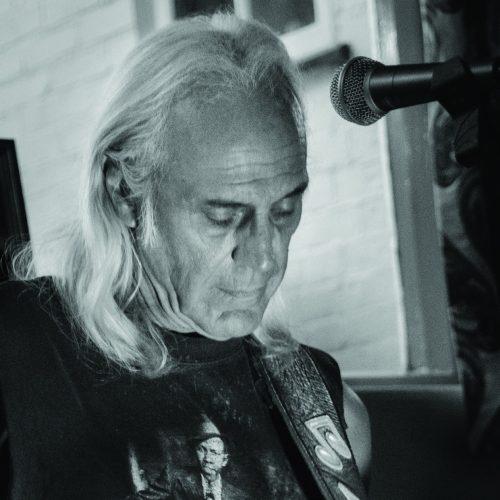
Northern Irishman Dino McGartland is well-known in the world of blues-rock for his editorship of Stagestruck, a much-admired Rory Gallagher fanzine which he published for several years from 1996. Now 59, McGartland has, amazingly, reinvented himself, releasing his own album, Hometown Blues, on which his Gallagher-influenced guitar impresses and which features star guests like Laurence Jones.
“What really satisfies me most is, it was done here in Omagh,” declares McGartland. “I just did it on my own using local musicians and a local studio, Outland. The experience was very, very enjoyable and it’s turned out very well, which shows that if you put your mind to it, you can do an album yourself without involving record companies and big studios.”
McGartland and his band recorded the album live, for the most part. “I’d grown up reading about old blues men and that’s the way they did it,” he explains. “They didn’t have high-tech equipment, they just went in and laid down a lot of tracks and I wanted to see if I could do that. Also, because I’d not really been in a studio before and didn’t know how things would work out, it was nice for me having the musicians there, sitting in a circle, and we were able to look at each other and give each other a nod to see which way things were going.”
The album contains a wide range of material. “I didn’t want a 100% blues album,” says McGartland. “There are blues standards, but I like Dylan as well, so there’s I Shall Be Released and Ryan Adams’ Excuse Me If I Break My Own Heart Tonight, which I’ve done completely different to the original.”
One of the guests on the album is Ronnie Greer, long Northern Ireland’s most interesting blues guitarist, who plays on Jimmy Reed’s Bright Lights Big City and Roy Hawkins’ The Thrill Is Gone. “Ronnie’s one of my favourite players,” says McGartland. “I love his tone
and enthusiasm and the way he plays, that crossover between blues and jazz, like Robben Ford. I would go and see him play quicker than I would go to see Eric Clapton!”
“[In the studio] he may have done about ten different solos and he kept saying, ‘Is that good enough?’ And I said, ‘Ronnie, even the bad ones are good!’”
Two Dublin guitarists, Eamonn McCormack and Dave McHugh, also guest on the album. “Eamonn lives in Germany where he’s a pretty big name,” explains McGartland. “We recorded the backing track live [for Freddie King’s Tore Down] and sent it to him and he did his part in Germany and then zipped a couple of versions of his solo back to us and said, ‘Whichever one you fancy, just put it in.’
“And Dave is a fantastic young guitarist. He just embodies everything that Rory Gallagher was with Taste – he has a great affinity with that stuff .”
The best-known guest, however, is probably Laurence Jones, who plays on I Shall Be Released and also Joe Thomas and Howard Briggs’ Got You On My Mind. “My daughter lives in Liverpool and got to know him, and happened to mention her dad was recording a CD and he says, ‘I’d be interested in playing on that,’” recalls McGartland. “So he flew in, and offthe
plane went to the studio and recorded the two tracks there and then. It was quite a scoop getting him but the funny thing was, he’d never heard of I Shall Be Released! I went, ‘You’re bound to have heard the song!’ But he’s only 22, a different generation, so no. But we played the track back to him three or four times and he laid down that guitar solo.”
McGartland sings on most tracks on the album. “I hate the sound of my voice!” he says. “That’s why I got Linda McLoughlin from The Kick The Bucket Blues Band to sing The Thrill Is Gone. She reminds me of Wanda Jackson, there’s a little quirkiness in her voice. And we got a young guy Caolan McCarthy to sing I Shall Be Released. But since the CD has come out, a lot of people have commented [favourably] on my voice.
So, horses for courses.”
Given his inexperience, one might imagine that McGartland would have found himself nervous to be in the studio with top rank players like Laurence Jones. “I was more nervous for them,” he says. “I was thinking, ‘I hope they’re happy with the way things are going down.’ I wasn’t actually nervous playing with them, the reason being some people like to rehearse and rehearse until everything’s perfect but I’d rather just jump in at the deep end. I like living on the edge.”
Perhaps the most obscure track on the album is Walter Parks’ Jesus Tone. “Whenever I’m on the internet searching for music and guitar players I’m always looking for ones that aren’t familiar or popular,” says McGartland. “So one night I came across Jesus Tone and the guys in the band all thought it was great.
“Recording the song I wanted to get that grittiness in my voice which I didn’t have so I used one of those bullet microphones. And I said to [engineer] Stevie Rafferty, ‘Can you make it sound a bit distorted and gritty with a little reverb?’ And it came out very well.”
McGartland’s great musical hero remains Rory Gallagher. “I just loved the way he played, the passion he had, his guitar sound and the way he used the Vox AC30,” he declares. “There’s only one Rory Gallagher. He’ll never be replicated.”
McGartland indeed regards Gallagher as crucial to his musical education. “In his sleeve notes or interviews he would always namecheck people like Earl Hooker or John Hammond or Big Bill Broonzy so I’d buy their records on the back of that,” he recalls. “That’s where I got a lot of inspiration.”
McGartland still remembers the first time he saw Gallagher in concert. “It was 2nd January 1975 at the Carlton cinema in Dublin,” he laughs. “And the ticket was £1.75! I’ll never forget it. We were just spotty kids and we were buzzing for weeks afterwards.
“Whenever you went to a Rory Gallagher gig you got the encore first! It was full steam right from the word ‘Go’. We used to come out saturated. You were every bit as wrecked as Rory was on stage. That was the attraction – and the fact you had two sides to him: the very humble, mannerly guy offstage and then once he plugged in he was just a complete tiger.”
When Gallagher played in McGartland’s home town Omagh in 1984 the two men actually met. “I slipped off work early and went to the venue and the guys were doing a soundcheck,” he reminisces. “I sat there and listened for maybe thirty minutes and then Rory came offstage and I went over and spoke to him. We talked about Muddy Waters and his influence on Rory and had a great chat.
“And then after the gig I was lucky enough to go back to the hotel and have another chat with him and have a beer. Everyone says you should never meet your heroes but Rory really was a lovely, lovely man. Whenever you talked, he listened to you. He was very humble and quiet.”
Following Gallagher’s sad death in 1995, aged 47, McGartland started the Stagestruck fanzine. “Whenever Rory passed away I felt we needed to have a way for the fans to communicate,” he explains. “But there was none of this modern technology then, it was all physically cutting and pasting, sticking bits of paper onto sheets of paper and taking the whole thing down to the printers, so it was a lot of work.
“But then the internet exploded and people wanted information very fast so the fanzine folded.”
It remains a mystery why Gallagher never quite achieved the superstardom that at one stage had seemed inevitable. “I don’t think he actually wanted to be a superstar,” reflects McGartland. “I think he was happy just as long as he was playing music. I don’t think he wanted to be the way Joe Bonamassa or Eric Clapton are. I don’t think that was his game at all. He didn’t want to be making videos and on MTV and touring stadiums and things like that. He was quite happy to play smaller venues where he could see the whites of his fans’ eyes.”
Gallagher had always seemed grounded and his deterioration in his final years, when he seemed to be derailed by various neuroses and a drink problem, was shocking. “He was very, very insecure and became very insular and didn’t want to go out,” says McGartland. “He probably felt he was a has-been and he lost confidence. The nerves were getting to him.”
McGartland found Gallagher’s decline upsetting. “Q magazine did an interview with him in July 1990 and his physical condition was shocking to see,” he recalls. “It was to do with the medication he was taking. But it was a shame the way he went in the end, because he was only a very young man.”
For much of McGartland’s own musical career, with local Omagh bands like South Pacific, The Diamonds and Stagefright, he has been unable to play the blues he loves. “It was the usual pub band music,” he sighs. “Whatever was in the charts. It can be demoralising doing that stuffbecause I wanted to play the blues but you played what people wanted you to play. And, OK, you got paid at the end of the night which was the reason you were there.
“But I’m very happy now to have this CD out and happy for people to be aware that it’s there. And I feel very privileged and chuffed that Blues Matters! have picked up on it. I really appreciate that.”
For more info visit: www.dinomcgartland.com